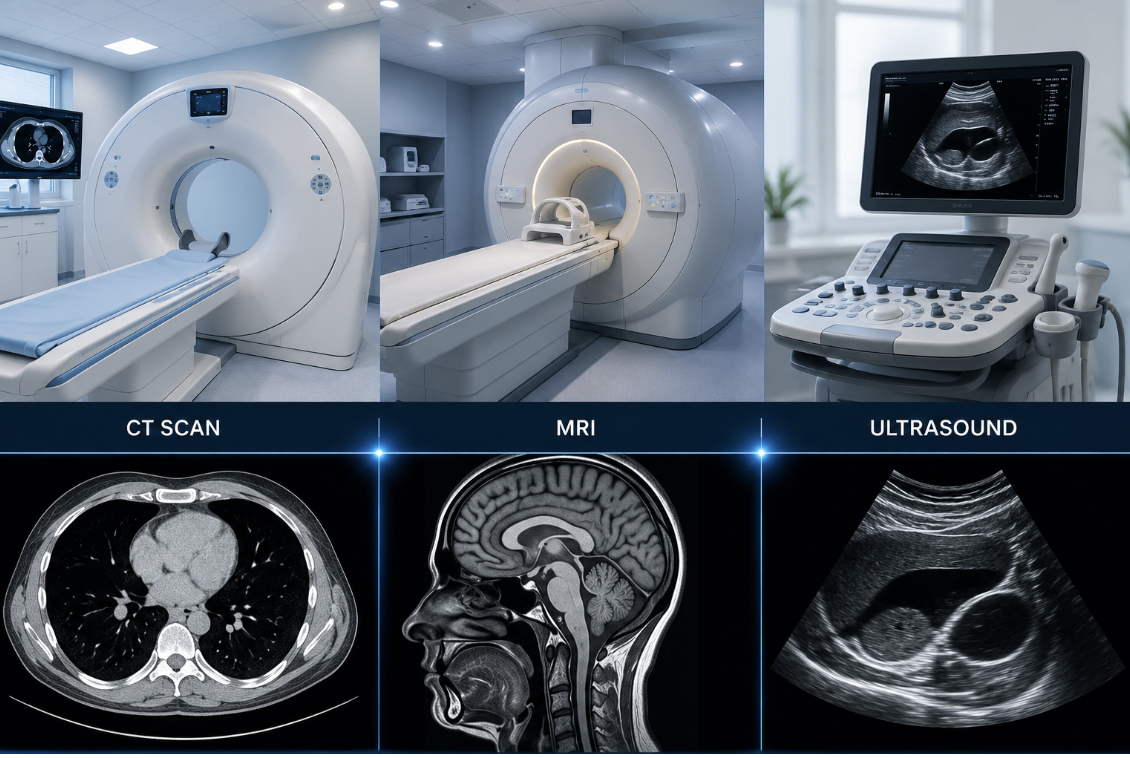
MRI vs. CT Scan vs. Ultrasound: Understanding the Differences
Medical imaging plays an important role in modern healthcare, helping physicians evaluate the body's internal structures without surgery. Whether used to investigate symptoms, monitor existing conditions, or support preventive health screening, imaging tests provide valuable information that may not be detected during a physical examination alone.
Three of the most commonly used imaging techniques are magnetic resonance imaging (MRI), computed tomography (CT), and ultrasound. While each serves a similar purpose of creating images of the inside of the body, they use different technologies and are best suited for different situations.
Understanding the differences can help you feel more informed if your healthcare provider recommends one of these imaging tests.
What Is an MRI?
Magnetic resonance imaging (MRI) uses a powerful magnetic field and radio waves to create highly detailed images of the body's soft tissues. Unlike CT scans, MRI does not use ionizing radiation.
MRI is particularly valuable for examining structures that may be difficult to evaluate with other imaging techniques.
An MRI may be recommended to evaluate:
- The brain and spinal cord
- Muscles, ligaments, and tendons
- Joints
- The liver, kidneys, and other internal organs
- Certain types of tumors and soft tissue abnormalities
Although MRI examinations generally take longer than CT scans, they provide exceptional detail for many soft tissue structures.
What Is a CT Scan?
A computed tomography (CT) scan uses a series of X-rays combined with advanced computer technology to create detailed cross-sectional images of the body.
Unlike a standard X-ray, which produces a single image, a CT scan generates multiple images from different angles that can be combined to provide a more detailed view of organs, bones, blood vessels, and other tissues.
CT scans are known for being fast and highly detailed, making them useful for evaluating many medical conditions.
A CT scan may be used to assess:
- The lungs and chest
- The abdomen and pelvis
- Bones and joints
- Certain cancers
- Blood vessels
- Coronary artery calcium as part of cardiovascular risk assessment
What Is an Ultrasound?
Ultrasound uses high-frequency sound waves to produce real-time images of structures inside the body. Like MRI, ultrasound does not use ionizing radiation.
Because it provides live imaging, ultrasound is especially useful for evaluating moving structures such as blood flow through vessels or the function of certain organs.
Ultrasound is commonly used to examine:
- The thyroid
- The liver and gallbladder
- The kidneys
- Blood vessels
- The pelvis
- Pregnancy and fetal development
- Various soft tissue structures
Ultrasound examinations are typically quick, painless, and non-invasive.
How Do They Compare?
Although all three imaging tests help healthcare providers evaluate the body, each has unique advantages.
MRI offers outstanding detail of soft tissues and is often preferred when evaluating the brain, spinal cord, joints, muscles, and certain internal organs.
CT scans are fast and provide excellent images of bones, lungs, blood vessels, and many internal organs.
Ultrasound provides real-time imaging without radiation and is particularly useful for examining soft tissues, blood flow, and abdominal or pelvic organs.
Which Imaging Test Is Best?
There is no single imaging test that is best for every situation.
The most appropriate examination depends on several factors, including:
- The area of the body being evaluated
- Your symptoms
- Your medical history
- The clinical question your healthcare provider is trying to answer
In some cases, more than one imaging study may be recommended because each provides different information that contributes to a more complete assessment.
The Role of Imaging in Preventive Healthcare
Medical imaging is not only used to diagnose illness after symptoms develop. Depending on an individual's age, family history, and personal risk factors, certain imaging tests may also play a role in preventive health screening.
When appropriate, imaging can help identify certain conditions before they cause noticeable symptoms, allowing for earlier evaluation and informed healthcare decisions.
The Bottom Line
MRI, CT scans, and ultrasound each play an important role in modern medicine. Although they all create images of the inside of the body, they use different technologies and are designed to evaluate different structures.
Understanding how these imaging techniques differ can help you better understand why a particular test may be recommended and how medical imaging supports early detection, accurate diagnosis, and personalized healthcare.