What Happens During an MRI? A Patient's Guide
For many people, having an MRI (magnetic resonance imaging) can feel unfamiliar or even intimidating. You may wonder what the scan involves, how long it will take, or whether there is anything you need to do to prepare.
The good news is that an MRI is a safe, non-invasive imaging test that provides detailed pictures of the body's organs and soft tissues without using ionizing radiation. Understanding what to expect can help make the experience more comfortable and less stressful.
What Is an MRI?
An MRI uses a powerful magnetic field and radio waves to create detailed images of structures inside the body. Unlike X-rays and CT scans, MRI does not use ionizing radiation.
Healthcare providers may recommend an MRI to evaluate a wide range of conditions involving the brain, spine, joints, muscles, ligaments, blood vessels, and internal organs. Depending on the reason for the examination, an MRI may focus on one specific area or, in some cases, multiple regions of the body.
Before Your MRI
Before your appointment, you will be asked questions about your medical history to help ensure the examination is appropriate and safe.
Your healthcare team may ask whether you have:
- A pacemaker or other implanted medical device
- Metal implants or surgical clips
- Cochlear implants
- Certain types of aneurysm clips
- Metal fragments in your body
- A history of previous surgeries
- Claustrophobia or anxiety in enclosed spaces
- Pregnancy or the possibility of being pregnant
Because MRI uses a strong magnetic field, it is important to remove metal objects before entering the scanning room. This may include jewelry, watches, hearing aids, hair accessories, eyeglasses, removable dental appliances, and credit cards.
Depending on the type of MRI being performed, you may be asked to change into a hospital gown.
During the MRI
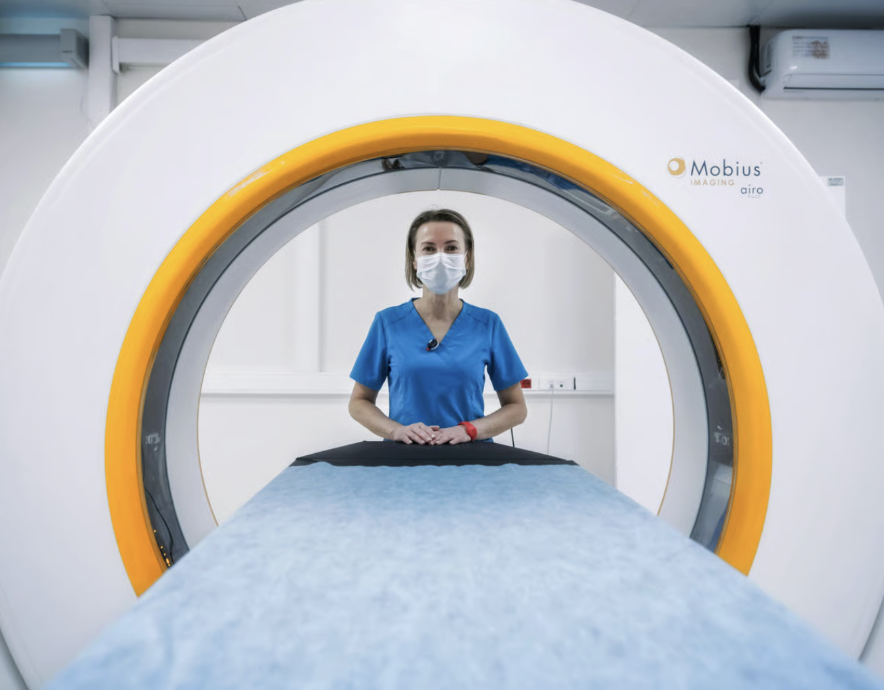
When it is time for your scan, you will lie comfortably on a padded examination table. The table slowly moves into the MRI scanner, which is shaped like a large cylinder.
Throughout the examination, it is important to remain as still as possible. Even small movements can affect image quality and may require portions of the scan to be repeated.
During the scan, you will hear a series of loud tapping or knocking sounds. These noises are a normal part of the imaging process. Earplugs or headphones are often provided to help make the experience more comfortable.
Although you will be alone in the scanning room during the examination, the MRI technologist can see, hear, and communicate with you at all times through an intercom system.
Will I Need Contrast?
Some MRI examinations require the use of a contrast agent to provide additional detail and help healthcare providers evaluate certain tissues or blood vessels more clearly.
If contrast is recommended, your healthcare provider will explain why it is needed and discuss any relevant medical history before the examination.
Not every MRI requires contrast, and its use depends on the reason for the scan.
How Long Does an MRI Take?
The length of an MRI examination varies depending on the area being examined and the number of images required.
Many MRI scans are completed within 30 to 60 minutes, although some studies may take more or less time.
Your healthcare team can provide a more specific estimate based on your individual examination.
After the Scan
Once your MRI is complete, you can usually return to your normal daily activities immediately unless your healthcare provider gives you different instructions.
A radiologist will carefully review the images and prepare a report for the healthcare provider who requested the examination. Your provider will then discuss the findings with you and explain whether any additional evaluation or follow-up is recommended.
Tips for a More Comfortable MRI Experience
If you are scheduled for an MRI, a few simple steps may help you feel more prepared:
- Arrive a little early to complete any necessary paperwork.
- Wear comfortable clothing, following any instructions provided by the imaging centre.
- Inform your healthcare team if you have implanted medical devices or metal in your body.
- Let your healthcare provider know if you experience claustrophobia or significant anxiety.
- Follow any preparation instructions you receive before your appointment.
Understanding the Process Can Help Ease Anxiety
It is normal to have questions before any medical test. Knowing what to expect during an MRI can help reduce uncertainty and make the experience more comfortable.
MRI is an important diagnostic tool that provides detailed images without using ionizing radiation. When recommended by your healthcare provider, it can play a valuable role in evaluating a wide range of medical conditions and supporting informed healthcare decisions.